Old Shuck
Amelia Opie’s journal is reported to name the dog passing between Beeston and Overstrand churchyards.
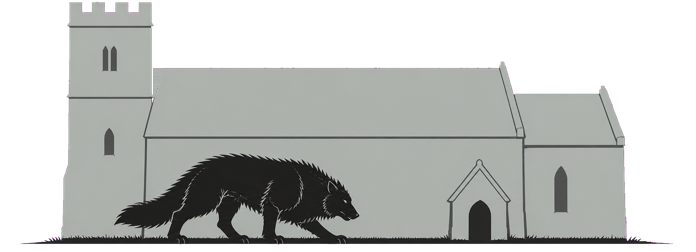
Names and relations
This page records the names used for Shuck, descriptions that were later treated as names, and other black hounds with traditions of their own.
How names are recorded
Later names are noted beside it, but are not carried backwards into an earlier account. Similar black-dog traditions are compared without automatically treating them all as Shuck.
Earliest uses found so far
The date belongs to the surviving record, not necessarily to the first time the name was spoken beside an East Anglian road.
Amelia Opie’s journal is reported to name the dog passing between Beeston and Overstrand churchyards.
Robert Forby includes the form in The Vocabulary of East Anglia, volume II, page 238.
E.S.T. prints Shuck, Shuck the Dog-fiend and Shuck’s Lane in Notes and Queries.
Arthur J. Rees uses the full compound in The Shrieking Pit, a Norfolk novel drawing upon local belief.
The name at the centre
Four forms are kept here with four different degrees of certainty. The gaps are part of the record.
E.S.T. put the name Shuck into print in 1850 and gave Shuck’s Lane at Overstrand. The notice belongs to East Norfolk and reaches into Cambridgeshire. It is the firmest early use so far inspected by this archive.
Secure in the inspected recordRobert Forby included Old Shock in his East Anglian vocabulary of 1830. Later dialect writing describes a road-going goblin that might take the shape of a great dog or calf. That shape-changing account is close to Shuck, though it need not describe precisely the same presence on every occasion.
Strong relation, identity not assumedA later account quotes Amelia Opie’s 1829 journal naming the churchyard dog between Beeston and Overstrand as Old Shuck. That would place the form before Forby and E.S.T., but the original journal page has not yet been located. It is an important lead, not yet a completed citation.
Reported in an 1829 journal; original page soughtBlack Shuck is now the name most readily understood. The 1850 notice, however, says Shuck, not Black Shuck. The earliest secure use of the full compound remains an open piece of work.
Recognisable; first use not yet establishedDescriptions in the sources
A description or broad class. A black dog in an old account is not automatically Shuck.
The heading chosen by E.S.T. in 1850. It tells us how the contributor framed Shuck, not what Shuck must be.
M. H. James’s chapter title in 1891. Her Suffolk marsh dog is later associated with Shuck, but she did not use that name.
A wide old word for a troubling presence. It is too broad to serve as another name for Shuck without local evidence.
Four records compared
The source wording is kept beside the archive’s finding. This prevents a later familiar name from becoming false testimony.
Source wordinga dog of black colour; the Devil in that likeness
Archive findingBlack Shuck is a later identification, not Fleming’s name.
→02Source wordingShuck; Shuck the Dog-fiend; Shuck’s Lane
Archive findingHere the name Shuck is directly attested.
→03Source wordingthe black dog; Bogie; the Hell Hound; dog fiend
Archive findingThe account is kindred, but Black Shuck is not used.
→04Source wordinga black dog which haunts the drawing room
Archive findingShuck is possible, but the surviving wording does not prove it.
→Other roads, other names
These accounts may help with comparison, but their own names, places and histories are retained. Resemblance alone does not make them Shuck.
North-west Norfolk
A spectral dog is locally reported about the golf course at Old Hunstanton. The collector expressly says it was not Black Shuck. With no witness name or event date yet supplied, it remains a separate modern report.
North Suffolk
A great dog-shaped apparition recorded in Suffolk dialect and folklore writing. Its own name and traits deserve to be kept, even where its country touches Shuck’s.
Yorkshire and the North
A northern black-dog tradition with its own local history. Resemblance may help comparison, but does not make Barghest another spelling of Shuck.
Northern England
Named for the sound or manner of its going, Pad-foot belongs to northern testimony. It is useful when comparing behaviour and omen traditions, not as an East Anglian alias.
Isle of Man
The Manx black dog belongs to a different island, language and body of testimony. It is kindred in appearance only until a source shows more.
Where the name may come from
In 1850, E.S.T. wondered whether Shuck came from shag, noting the Norfolk word shucky for shaggy. Other writers have looked to older forms of the word. The question remains open until those forms and their dates have been checked directly.
Sources consulted
Older sources are used for what they actually preserve. A later work may help comparison, but it cannot prove that an earlier witness used a name.
Robert Forby, volume II, 1830. See the entry for Old Shock on page 238.
Primary dialect source identified. The page image remains on the archive’s inspection list.E.S.T., Notes and Queries, no. 29, 18 May 1850, page 468.
Primary printed notice inspected in full.Elizabeth Mary Wright, 1913. See the comparative black-dog notices in the chapter on supernatural beings.
Public-domain comparative source. It preserves distinctions as well as likenesses.Sam Newton, Proceedings of the Suffolk Institute of Archaeology and History, 2016.
Modern scholarly context for Old Shock, Shuck and the East Anglian record.Arthur J. Rees, 1919. The novel contains a direct printed use of the full name Black Shuck.
Primary printed use inspected. It is the earliest secure full compound yet located, not a claim that none earlier exists.The next question
The full compound is secure by 1919, but may be older. Newspapers, county glossaries and local books from the intervening years must now be searched without mistaking a later catalogue description for the words upon the page.
See how the archive works